
Table of Contents
- Introduction
- How Long Can a Portable Power Station Run a Refrigerator?
- Why Refrigerator Runtime Is Harder to Calculate
- How to Calculate Refrigerator Runtime
- What Affects Refrigerator Runtime During a Blackout?
- How Much Battery Capacity Do You Need?
- Can a Power Station Run a Refrigerator for 24 Hours?
- How to Keep Your Refrigerator Running Longer During an Outage
- Can You Run Other Appliances at the Same Time?
- What to Look for in a Power Station for Refrigerator Backup
- FAQ
- Conclusion
Introduction
When the power goes out, keeping your refrigerator running is one of the first things most households think about. Food can spoil quickly without power, especially during a summer heatwave or an extended grid failure. Beyond the cost of replacing groceries, there's the inconvenience of dealing with a defrosted freezer.
A portable power station can provide a practical backup solution, but how long can it actually run a refrigerator? The answer depends on several factors: your refrigerator's energy consumption, the power station's battery capacity, inverter efficiency, and how often the compressor runs. In this guide, we'll explain how to estimate runtime, what capacity you need, and how to make your backup power last longer.

How Long Can a Portable Power Station Run a Refrigerator?
There is no single answer that applies to every refrigerator. Modern refrigerators cycle their compressors on and off rather than consuming maximum power continuously. A refrigerator with an average running draw of 50–100W may use considerably less energy over a full day because the compressor periodically switches off.
|
Power Station Capacity |
Approximate Refrigerator Backup* |
|
500Wh |
Several hours |
|
1,000Wh |
Around half a day or longer |
|
2,000Wh |
Around a day or longer |
|
3,000Wh+ |
Extended backup |
*Actual runtime depends on refrigerator energy consumption, compressor cycling, ambient temperature, and power station efficiency.
Battery capacity alone does not determine runtime.
Why Refrigerator Runtime Is Harder to Calculate
A Refrigerator Doesn't Run at Full Power All the Time
One common mistake is assuming a refrigerator continuously consumes its rated wattage. A compressor switches on when cooling is needed and off once the target temperature is reached. So a 100W running power does not mean 100W × 24h = 2,400Wh per day. Actual daily consumption is much lower because the compressor cycles.
This is why annual energy consumption figures (kWh/year) are more useful than rated running wattage.
Startup Power Can Be Higher Than Running Power
Compressors require a brief surge of power when starting. Your power station needs enough continuous AC output for normal operation and enough peak/surge output to handle startup. A 100W fridge may need 400–600W for a split second. If your station's surge rating is too low, it may trip even with plenty of battery remaining.
Your Refrigerator's Energy Consumption Matters Most
Check your refrigerator's energy information. Look for:
- Energy consumption in kWh/year
- Rated power in watts
- Energy label or user manual
If annual consumption is provided, divide by 365 to estimate daily use. Example: 300kWh/year ÷ 365 ≈ 0.82kWh/day (820Wh/day). Real‑world consumption varies with temperature and usage, but this gives a useful starting point.
How to Calculate Refrigerator Runtime
A simple estimate:
Estimated Runtime = Usable Battery Capacity ÷ Average Refrigerator Power Consumption
But remember, battery capacity isn't delivered to AC appliances with 100% efficiency. DC‑to‑AC conversion loses some energy. A more realistic calculation:
Estimated Runtime = Battery Capacity × Conversion Efficiency ÷ Average Power Consumption
Example: 1,024Wh station, 50W average fridge draw, 85% efficiency:
1,024Wh × 85% ÷ 50W ≈ 17.4 hours
This is an estimate, not a guarantee. Actual results depend on the fridge, temperature, and station.

What Affects Refrigerator Runtime During a Blackout?
Refrigerator Size and Efficiency – A small, modern fridge consumes less than a large older model. Insulation, compressor type, and design all matter.
Ambient Temperature – This is a major factor. On a hot summer day, the compressor runs more frequently. In Southern Europe (Spain, Italy, Greece), summer blackouts with 35°C indoor temperatures can nearly double your fridge's energy use. Consider adding a safety margin and choosing a capacity one step larger than your basic calculation suggests.
Door Openings – Every time you open the door, cold air escapes. Minimize unnecessary openings during an outage.
Freezer Use – A fridge‑freezer combo consumes more than a fridge‑only unit because the freezer must maintain a much lower temperature.
Power Station Efficiency – Some energy is lost during DC‑to‑AC conversion. This is why real‑world runtime is always somewhat lower than a simple capacity calculation might suggest.
How Much Battery Capacity Do You Need?
500Wh – Useful for short outages or smaller fridges. Works if your priority is just keeping food cool until power returns, but adding other devices reduces runtime.
1,000Wh – A good balance for many households. Provides many hours of backup and can also power small essentials like lights and phone charging overnight.
2,000Wh – Substantially more energy. Can potentially run a fridge for a full day or more, depending on consumption, with room for other essentials.
3,000Wh+ – For extended outages or running multiple devices simultaneously.
Decision reference:
|
Expected outage |
Minimum capacity |
Tip |
|
Under 4 hours |
500–800Wh |
Reserve for fridge only |
|
Overnight (8–12h) |
1,000–1,500Wh |
Can also power lights and charge phones |
|
24h or more |
2,000Wh+ |
Strongly consider solar panels for daytime recharging |
Can a Power Station Run a Refrigerator for 24 Hours?
It can, but it depends on your fridge's daily consumption. If your fridge uses 600–800Wh/day, a 2,000Wh station gives you more flexibility than a 500Wh model. But don't assume 2,000Wh automatically guarantees 24 hours—temperature, compressor cycling, and inverter efficiency all affect runtime.
For outages longer than a day, adding solar panels is especially useful.
Solar Panels Can Extend Backup Time
Solar panels can replenish some of the energy your fridge uses during daylight hours, turning a portable power station from a short‑term emergency battery into a more sustainable backup system for longer outages. Solar output depends on panel wattage, sunlight, weather, orientation, and charging conditions.
Important: If you plan to use solar during an outage, check that your station supports pass‑through charging (charging and discharging simultaneously). Not all models do, and this feature matters for multi‑day blackouts.
How to Keep Your Refrigerator Running Longer During an Outage
Small habits can make a noticeable difference:
- Keep the door closed – Open only when necessary. Less cold air escaping means fewer compressor cycles.
- Avoid adding hot food – Warm items increase cooling load. During an extended outage, don't put warm food in the fridge unnecessarily.
- Fill empty space with water bottles – A full fridge holds cold better than an empty one. Plastic bottles filled with tap water act as thermal mass, stabilising temperature and reducing compressor cycling.
- Keep the power station cool and ventilated – Follow the manufacturer's instructions. Place it in a ventilated spot away from heat.
- Turn off non‑essential devices – Every extra device reduces energy available for the fridge.
- Disable "Eco" mode (if your station has it) – Some power stations have an energy‑saving mode that cuts AC output when they detect very low draw. Because a fridge cycles on and off, this can confuse the mode and cause it to cut power unexpectedly. For fridge use, turn this feature off.
- Recharge with solar when available – If you have solar panels, recharge during daylight hours to extend backup.
Can You Run Other Appliances at the Same Time?
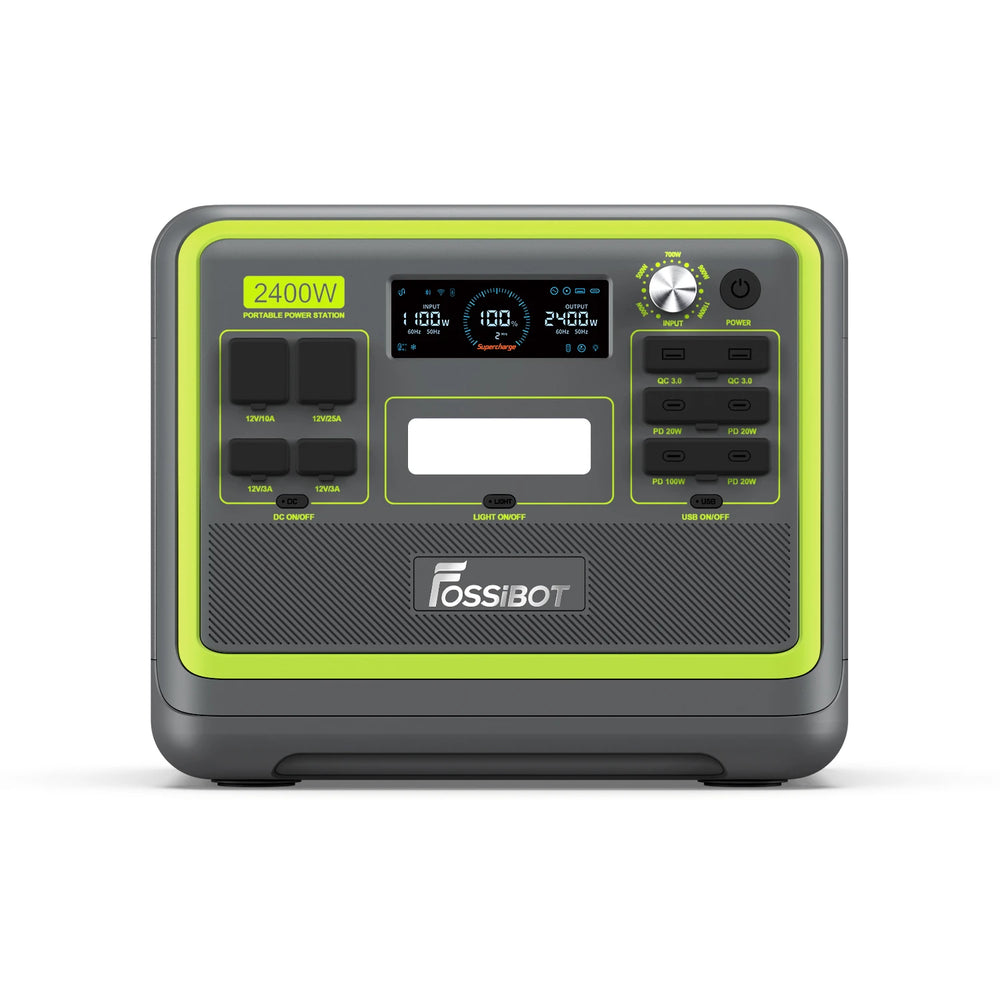
Yes, as long as the total power demand stays within the station's continuous output rating. Low‑power devices like Wi‑Fi routers, LED lights, phones, and laptops can often run alongside a fridge. But high‑power appliances—kettles, microwaves, heaters, air conditioners—can consume hundreds or thousands of watts and will drain your battery quickly.
Remember the difference: Watts (W) tell you how much power an appliance needs at a given moment. Watt‑hours (Wh) tell you how much energy a battery can store. W determines what you can run; Wh determines how long you can run it.
What to Look for in a Power Station for Refrigerator Backup
- Battery Capacity (Wh) – Larger means more stored energy and generally longer runtime.
- AC Output – Ensure continuous output is sufficient for your fridge and any other devices.
- Peak/Surge Output – Must handle compressor startup spikes (3–5x running wattage).
- UPS Function – If you want seamless switchover during an outage, look for a switchover time under 10ms to keep your fridge and sensitive electronics running smoothly.
- Solar Charging Input – Essential for multi‑day outages.
- LiFePO₄ Battery – Offers long cycle life (3,000–5,000 cycles). If you plan regular use, this chemistry provides better long‑term value.
FAQ
Can a portable power station run a refrigerator overnight?
Yes. A suitable station can run a fridge overnight, but exact runtime depends on the fridge's consumption and the station's usable capacity.
Can a 1000W power station run a refrigerator?
Usually yes, but only if its surge output can handle startup. Remember: 1000W is output power, not battery capacity—check the Wh rating for runtime.
How many watt‑hours does a refrigerator use per day?
It varies. Check the energy label for kWh/year, then divide by 365 to get a daily estimate.
Can a 2000Wh power station run a refrigerator for 24 hours?
It depends. Lower‑consumption fridges (under 800Wh/day) may run 24+ hours, but higher‑consumption models likely won't.
Can I run a refrigerator and other appliances at the same time?
Yes, if total power draw stays within the station's continuous output rating and startup surges stay within peak capability.
Can solar panels recharge a power station while it runs a refrigerator?
Many models support this, but not all—check your station's specifications for pass‑through charging support.
Is a 500Wh power station enough for a refrigerator?
Yes for short outages, but not for extended ones. Also check the station's surge output—if it can't handle startup, the fridge won't start at all.
How long do LiFePO₄ power stations last?
Typically 8–10 years with daily use. Most are rated for 3,000–5,000 full cycles before dropping to 80% capacity.
Conclusion
A portable power station can be a practical way to keep your refrigerator running during a blackout, but there's no universal answer to how long it will last. The key factors are your fridge's actual consumption, the station's usable capacity, compressor startup requirements, inverter efficiency, and environmental conditions.
For short outages, a smaller station may be enough. For overnight or extended blackouts, 1,000Wh–2,000Wh or larger gives more flexibility, especially if you need to power other essentials. For multi‑day outages, adding solar charging makes a significant difference.
The best approach is simple: check your fridge's annual kWh figure, choose enough capacity for your expected outage, and ensure the station has sufficient AC and surge output.
Next step: Take two minutes to find your fridge's energy label. Compare it with the capacities discussed here—and you'll know exactly what size fits your home. A little preparation today can save a lot of food—and stress—tomorrow.


