
Table of Contents
- Introduction
- Is 2,048Wh Enough for Your Everyday Power Needs?
- What Does 3,000W Output Mean in Real Use?
- One Power Station, Three Common Ways to Use It
- Recharge the F3000 Your Way
- Solar Charging for Longer Trips
- What Happens When the Power Goes Out?
- Smarter Energy Management with Smart ECO Mode
- Choose How Fast You Want to Charge
- Built for Frequent Use
- FOSSiBOT F3000 Specifications at a Glance
- Frequently Asked Questions About the FOSSiBOT F3000
- Is the FOSSiBOT F3000 Right for You?
Introduction
A portable power station can do much more than keep your phone charged. With enough battery capacity and output power, it can become a practical source of electricity for camping, RV travel, home backup, DIY projects, and everyday devices.
The challenge is knowing what specifications actually matter.
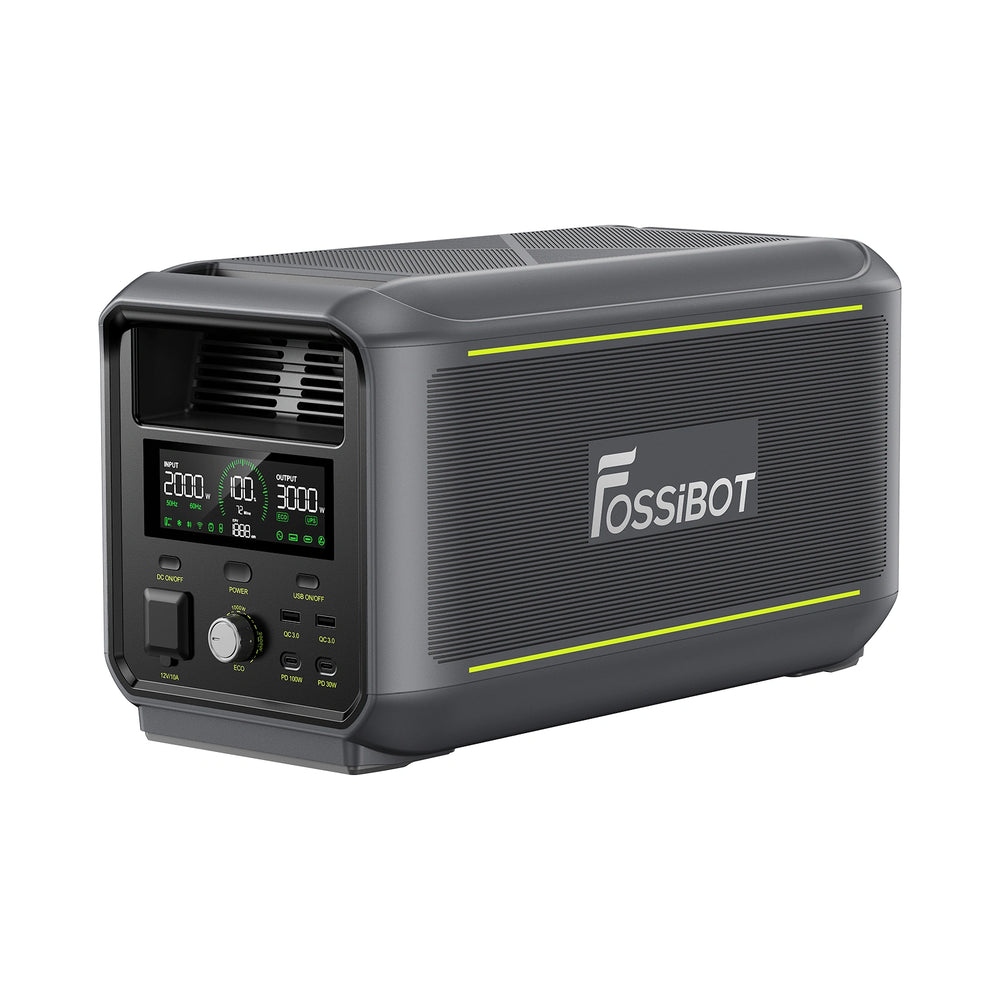
The new FOSSiBOT F3000 combines a 2,048Wh battery capacity, 3,000W continuous output, and up to 6,000W peak power in one portable power station. It also supports up to 1,200W solar input, fast AC charging, UPS functionality, Smart ECO Mode, and app control.
Instead of looking at specifications one by one, this guide takes a practical approach: what can a 2,048Wh, 3,000W power station actually do, how can you recharge it, and when does a system like the F3000 make sense?

Is 2,048Wh Enough for Your Everyday Power Needs?
Battery capacity is one of the first things to consider when choosing a portable power station.
The F3000 stores 2,048Wh of energy, giving you considerably more energy reserve than a small power bank or compact portable battery. But the actual runtime depends on what you connect to it.
A useful estimate is:
Estimated runtime ≈ Battery capacity (Wh) × 0.85 ÷ Device power (W)
Using the F3000 as an example:
- A 60W portable fridge could run for approximately 29 hours
- A 100W electric blanket could run for approximately 17.4 hours
- A 200W desktop computer could run for approximately 8.7 hours
- A 300W projector could run for approximately 5.8 hours
- A 1,000W microwave could run for approximately 1.7 hours
These figures are estimates rather than guaranteed runtimes. Actual performance depends on the device, operating conditions, power conversion losses, and whether the appliance runs continuously at its rated power.
For appliances such as refrigerators and air conditioners, the compressor may cycle on and off, so real-world runtime can differ from a simple calculation.
What Does 3,000W Output Mean in Real Use?
Capacity determines how long you have energy available. Output power determines what you can run at the same time.
The F3000 provides up to 3,000W of continuous AC output, with up to 6,000W of peak power.
This gives you enough output headroom for many higher-power household, outdoor, and workshop appliances.
For example, depending on their actual rated power, the F3000 can be used with devices such as:
- Microwave ovens
- Induction cooktops
- Electric grills
- Coffee makers
- Hair dryers
- Power tools
- Portable refrigerators
- Projectors
- Computers and networking equipment
The 6,000W peak output is particularly useful for appliances and tools that briefly draw more power when starting.
This distinction is important when choosing a power station. A large battery does not automatically mean it can run a high-power appliance. You need to consider both capacity (Wh) and output power (W).
One Power Station, Three Common Ways to Use It
The F3000 is designed around different types of power needs rather than one specific environment.
1. Camping: From Refrigeration to Entertainment
For camping trips, electricity is often needed for several small loads rather than one large appliance.
A portable fridge can keep food and drinks cold, LED lights can provide illumination after dark, and a projector can turn an evening outdoors into a movie night.
For example, a 60W portable fridge has an estimated runtime of around 29 hours, while a 20W LED camping light could theoretically run for around 87 hours.
If you need higher-power cooking equipment, the F3000's 3,000W continuous output provides more room for devices such as electric grills and induction cooktops.
For longer trips, compatible solar panels can be used to replenish the battery during the day, helping extend your time away from a traditional power outlet.
2. Home Backup: Keep Essential Devices Running
A power outage does not necessarily mean you need to power your entire home.
In many situations, the priority is keeping essential devices operating: your router, computer, lights, refrigerator, or other electronics.
The F3000 can provide temporary backup power for these loads. A 15W Wi-Fi router, for example, has an estimated runtime of around 116 hours under the calculation above, while a 200W desktop computer could run for approximately 8.7 hours.
For higher-power appliances, the available runtime is shorter, but the 3,000W output gives you the flexibility to operate many devices that smaller power stations cannot handle.
This makes the F3000 useful not only for emergencies, but also whenever you need temporary power without relying on a wall outlet.
3. RV Travel: Power Wherever the Road Takes You
An RV can turn electricity into a daily necessity. Refrigeration, coffee makers, kettles, cooking equipment, entertainment systems, and air conditioning can all add to your energy demand.
With 2,048Wh of battery capacity and 3,000W continuous output, the F3000 can support a wide range of RV appliances.
For example, a 1,200W RV air conditioner has an estimated runtime of around 1.5 hours, while a 1,500W appliance could run for around 1.2 hours under the same calculation.
When parked, you can recharge the F3000 with solar power. When driving, the FAC580 DC-DC charger provides another way to replenish the power station from the vehicle's electrical system.
This gives RV users more than one way to manage their energy between stops.

Recharge the F3000 Your Way
A large battery is only useful if you can recharge it conveniently.
The F3000 supports six charging methods, allowing you to choose the power source that best fits your situation:
- AC charging
- Solar charging
- AC + Solar charging
- Generator charging
- DC-DC charging
- Car charging
Its maximum AC input reaches 2,000W, while the maximum solar input is 1,200W.
With AC and solar charging combined, the total input can reach up to 2,000W, allowing a full recharge in approximately 1.2 hours under suitable conditions.
|
Charging method |
Maximum input |
Approx. charging time |
|
AC + Solar |
2,000W |
≈ 1.2 hours |
|
AC |
2,000W |
≈ 52 min to 80% |
|
Solar |
1,200W |
≈ 1.6 hours |
|
Generator |
2,000W |
≈ 1.2 hours |
|
DC-DC |
580W |
≈ 4 hours |
|
Car |
120W |
≈ 17 hours |
Actual charging time can vary depending on the power source, temperature, charging conditions, and available solar power.
Solar Charging for Longer Trips
Solar charging becomes particularly useful when access to the grid is limited.
The F3000 accepts up to 1,200W of PV input, allowing it to be paired with compatible solar panels for off-grid charging.
For example, the estimated charging times with different FOSSiBOT solar panel combinations are:
- 3 × SP400 Pro: approximately 2.6 hours
- 3 × SP200 Pro: approximately 3.4 hours
- 3 × SP100 Pro: approximately 6.8 hours
When configuring solar panels, the electrical limits of the F3000 need to be considered. The PV input supports up to 25A, and the total open-circuit voltage (Voc) of a series connection must not exceed 60V.
For longer camping or RV trips, solar charging can therefore work as a way to replenish energy during the day rather than relying entirely on a fixed electrical connection.
What Happens When the Power Goes Out?
For home use, one of the most useful features of the F3000 is its UPS function.
When connected equipment needs uninterrupted power, the F3000 can switch to battery power in less than 10ms when the grid supply is interrupted.
In UPS mode, the maximum output is 2,000W.
This can be useful for equipment such as:
- Desktop computers
- Wi-Fi routers and modems
- NAS devices
- CPAP machines
- Other essential electronics
The goal is not necessarily to keep every appliance in your home running indefinitely. Instead, a UPS can help maintain power for selected devices while you deal with a short interruption or wait for another power source to become available.
Smarter Energy Management with Smart ECO Mode
Power management becomes more important when multiple energy sources are available.
The F3000's Smart ECO Mode is designed to manage solar power, grid electricity, and battery energy more intelligently.
Depending on the available energy and battery level, the system can prioritize available power sources and reduce unnecessary switching between the grid and battery.
This is particularly useful for people who use the F3000 as part of a semi-permanent home backup setup or regularly combine it with solar power.
You can also manage the power station through the FOSSiBOT app, including:
- Checking battery level and remaining runtime
- Monitoring input and output power
- Adjusting charging settings
- Setting charge and discharge limits
- Scheduling charging and discharging
- Managing Smart ECO Mode
- Adjusting device settings
Instead of walking over to the power station every time you want to check its status, you can monitor key information from your phone.
Choose How Fast You Want to Charge
Maximum charging speed is not always the most convenient option.
The F3000 features a physical control that allows you to select between three AC charging levels:
500W → 1,000W → 2,000W
For example, if other appliances are already using power from the same household circuit, selecting a lower charging level can help reduce the instantaneous load.
At other times, when fast charging is the priority, the 2,000W setting can be used to take advantage of the available AC input.
This gives you more control than simply switching between “charging” and “not charging.”
Built for Frequent Use
The F3000 uses a LiFePO₄ battery rated for 4,000+ cycles.
Its integrated Battery Management System (BMS) monitors the battery during charging and discharging and provides protection against conditions such as overtemperature, overcurrent, and overvoltage.
For users who plan to use a power station regularly rather than only once or twice a year, battery chemistry and battery management are important considerations.
The F3000 is also designed to remain practical for everyday use. It measures 461 × 220 × 252mm and weighs approximately 19.2kg (42.3 lbs).
Its specified noise level is below 35dB, although actual noise can vary depending on the operating load and conditions.

FOSSiBOT F3000 Specifications at a Glance
|
Specification |
FOSSiBOT F3000 |
|
Battery capacity |
2,048Wh |
|
Continuous output |
3,000W |
|
Peak output |
6,000W |
|
Battery type |
LiFePO₄ |
|
Battery cycles |
4,000+ |
|
Maximum AC input |
2,000W |
|
Maximum solar input |
1,200W |
|
AC + Solar input |
Up to 2,000W |
|
UPS transfer time |
<10ms |
|
UPS output |
Up to 2,000W |
|
Weight |
19.2kg (42.3 lbs) |
|
Dimensions |
461 × 220 × 252mm |
|
Noise level |
<35dB |
|
AC charging levels |
500W / 1,000W / 2,000W |
|
Warranty |
2+3 years |
Frequently Asked Questions About the FOSSiBOT F3000
How long can the F3000 run a refrigerator?
It depends on the refrigerator's actual energy consumption and how often its compressor operates.
As an example, a 60W portable fridge has an estimated runtime of approximately 29 hours using the 2,048Wh × 85% calculation.
Can I charge the F3000 with solar panels and use it at the same time?
Yes. The F3000 supports using the power station while it is charging. This can be useful for outdoor and RV applications where solar energy is available during the day while appliances are still operating.
How quickly can the F3000 be fully charged?
With a combined AC + Solar input of up to 2,000W, the F3000 can be fully charged in approximately 1.2 hours under suitable conditions.
Using solar power alone, the maximum PV input is 1,200W, with an estimated full charging time of approximately 1.6 hours under suitable conditions.
Can the F3000 be used as a UPS?
Yes. The F3000 supports UPS functionality with a transfer time of less than 10ms and up to 2,000W output in UPS mode.
Is the F3000 suitable for RV use?
Yes. Its 2,048Wh capacity and 3,000W continuous output make it suitable for a range of RV appliances, including refrigerators, coffee makers, cooking equipment, and air conditioning within the available power range.
For additional charging options, solar power can be used when parked, while the FAC580 DC-DC charger can recharge the F3000 from the vehicle's electrical system while driving.
Can I control the F3000 from my phone?
Yes. The FOSSiBOT app allows you to monitor battery and power information, adjust charging settings, set charging and discharging limits, schedule operation, and manage Smart ECO Mode.
What is the difference between 2,048Wh and 3,000W?
They describe two different aspects of the power station.
2,048Wh refers to the amount of energy the battery can store, while 3,000W refers to the maximum continuous power the F3000 can deliver.
In simple terms, Wh is mainly related to how long you can use your stored energy, while W is related to what kind of load the power station can support.
Is the FOSSiBOT F3000 Right for You?
The F3000 is designed for users who need more than basic portable charging but do not want to rely on a fixed backup power system.
Its combination of 2,048Wh capacity and 3,000W continuous output gives you enough energy storage for longer low-power loads while also providing the output needed for many higher-power appliances.
With multiple charging options, up to 1,200W solar input, <10ms UPS functionality, Smart ECO Mode, app control, and a LiFePO₄ battery, the F3000 can adapt to different power needs.
Whether you are preparing for a camping trip, looking for temporary home backup, planning an RV journey, or simply need a portable source of high-power electricity, the FOSSiBOT F3000 is built to give you more flexibility over where and how you use your energy.


